 FormaGet Forma
Do light weights build muscle, or do you have to lift heavy?
Load alone does not decide hypertrophy. Lighter sets can grow muscle when effort is high, while heavier sets have a clearer advantage for maximal strength. The bar weight you record describes the task, not the stimulus inside the muscle.
Published and last reviewed November 5, 2026 · 7-minute read
Published by Forma · Editorial responsibility: Aymane Belarbi, founder
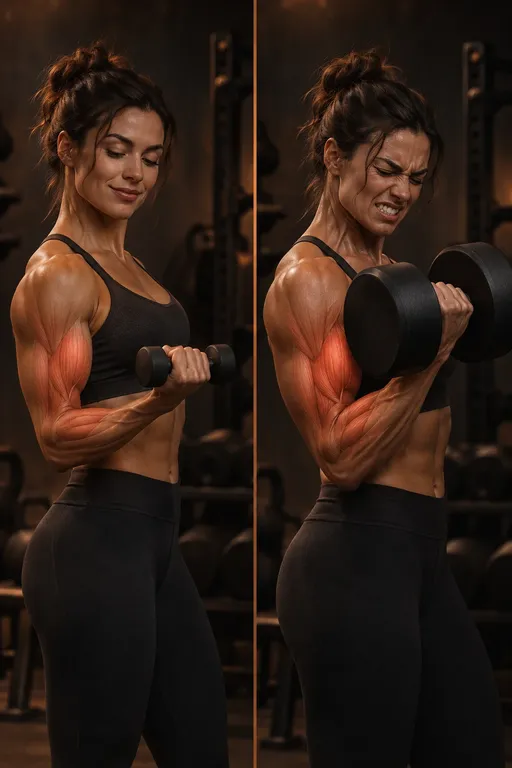
Load goals and what the evidence supports
| Goal | What the evidence supports | What it does not say |
|---|---|---|
| Muscle size | Similar hypertrophy across higher and lower loads when sets reach or approach failure | That very light sets taken with low effort produce the same growth |
| Maximal strength | Higher loads produced greater gains in 1RM and isometric strength | That lighter training builds maximal strength as well as heavier training |
| Effort on lighter sets | Lighter sets matched heavier ones only when effort was high | That a fixed repetition count or percentage guarantees the same outcome |
| Time per session and total reps | Lighter sets usually need more repetitions per set to reach high effort | That extra repetitions are free, since they add time, fatigue and discomfort |
| Joint comfort and exercise choice | Equipment and exercise choice change how a given load feels and how it loads the muscle | That any exercise or machine gives the same result at the same number on the log |
What the meta-analyses show, and where they stop
A 2017 systematic review and meta-analysis compared low-load and high-load resistance training. Hypertrophy was similar between the two when sets were taken to or close to failure, while strength gains favored the heavier loads. A 2021 systematic review and meta-analysis of 45 studies reached a similar picture across whole-body, whole-muscle and fiber measures, with higher loads producing greater gains in 1RM and isometric strength.
A network meta-analysis of resistance-training prescriptions separates the contributions of load, sets and weekly frequency, which is a reminder that load is one variable among several. The catch is plain: lighter sets only match heavier ones when effort is high, and that usually means more repetitions per set and more discomfort. These studies used trained protocols, and they do not cover every load, population or exercise.
What decides the choice of load
Proximity to failure
Effort is the strongest signal in the evidence. Lighter and heavier loads were similar for muscle size when sets were taken close to failure, so a light set that stops far from failure is a different training task.
Time and total repetitions
Lighter sets usually need more repetitions to reach high effort, which adds session time and fatigue. Heavier sets reach high effort with fewer repetitions, which can suit a schedule or a strength goal better.
Exercise and equipment fit
A movement you can perform with a controlled range and a repeatable setup makes the load easier to judge. Machines, free weights and cables load the muscle differently, so the same number on a log does not mean the same demand.
The bar load is a record of the task, not the stimulus
The weight on the bar or machine is useful for tracking progress, but it does not measure how much tension reaches the muscle. Moment arms, range of motion, exercise mechanics and effort all change the stimulus, so a heavier number alone does not prove more growth.
A practical sequence for choosing and reviewing load
Pick a load you can control
Choose a weight that lets you complete the planned repetitions with consistent technique and a range you can repeat from set to set.
Take working sets close to failure
Near-failure effort is the condition the evidence links to similar growth across loads. If you use RIR, record how many repetitions you believed you had left.
Give lighter and heavier work a purpose
Heavier sets can serve a strength goal, and lighter sets can serve a volume or comfort goal. Decide what each exercise is for instead of ranking load as better or worse.
Review load, reps and weekly sets together
Look at load, repetitions, effort and weekly sets across several weeks. Adjust when the trend stalls, rather than reacting to a single session.
Do you know how close to failure your light sets really are?
Forma keeps exercise, load, reps, optional RIR and weekly volume in one view, so you can check whether a lighter set was taken with real effort. These are logged records, not a direct measure of the stimulus in the muscle. Free to download. Forma Pro is optional.
Not ready for an app? Read RIR and effort or Overload versus training to failure.

Frequently asked questions
Do light weights build muscle?
Yes, they can, when sets are taken close to failure. The evidence found similar hypertrophy between lower-load and higher-load training under those conditions. Light sets taken with low effort are a different matter.
Do I have to lift heavy to grow?
No. Heavier loads have a clearer advantage for maximal strength, but hypertrophy was similar across loads in the studied conditions. Effort, total work and progression still matter.
Are light sets as good as heavy sets for strength?
Not according to the reviewed evidence. Higher loads produced greater gains in 1RM and isometric strength, so heavier work is the better match for a strength goal.
How hard should light sets be?
Light sets need high effort to match heavier sets for muscle size, which usually means more repetitions and more discomfort. The studies used trained protocols and do not cover every load, population or exercise.
Primary references
Systematic review and meta-analysis, 2017. PMID: 28834797.
A 2021 systematic review and meta-analysis of 45 studies.
A network meta-analysis separating load, sets, and weekly frequency.
Continue the load and overload guides
Track the load, the effort and the task.
Forma records exercise, load, reps, optional RIR and weekly volume so you can review what you actually did. Heavy or light, the log shows the task, and effort is what the evidence links to growth. Record load and reps for every set with the weight lifting tracker.
Read the mechanical tension guideDownload Forma